
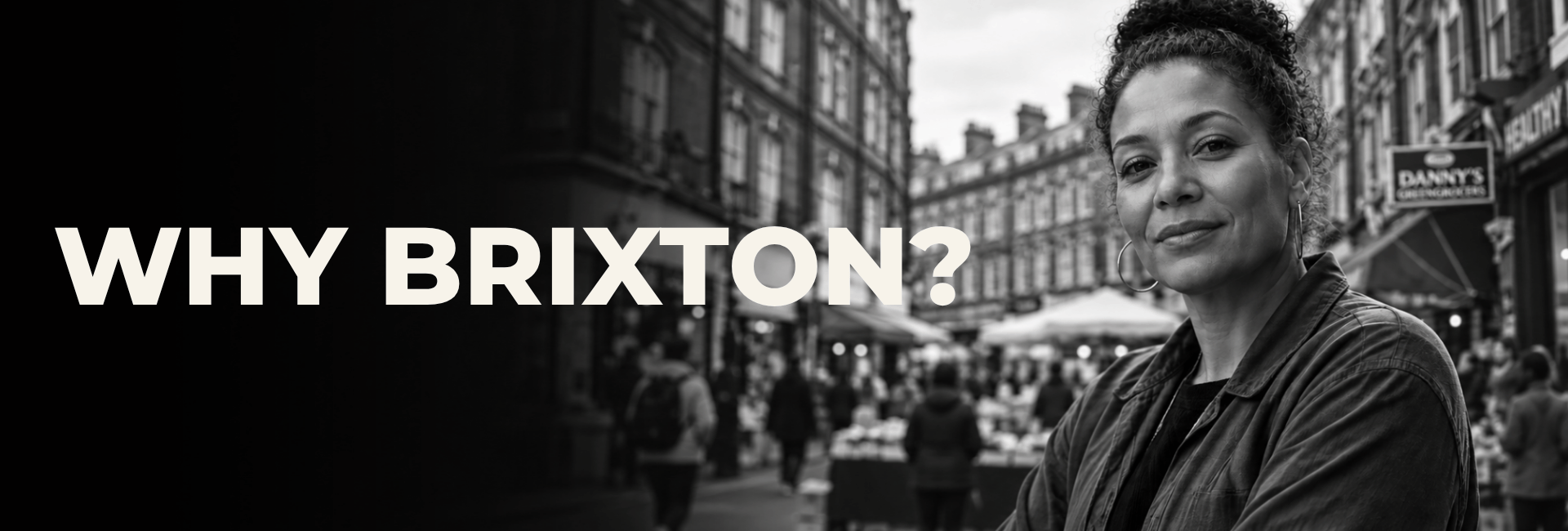
AS OUR HOME CHANGES, WHO STILL FEELS AT HOME?
This isn’t about race, and it isn’t about deciding who does or does not belong in Brixton.
Spend time in Brixton during the day and you see an extraordinary social and cultural mix: different generations, backgrounds and communities sharing the same streets, shops, market, buses and public spaces.
But move through parts of Brixton in the evening and that same mix is far less visible than it once was, in some places, almost non-existent.
That matters enormously to the people who call Brixton home.
A neighbourhood can be diverse on paper and still contain spaces that do not feel equally accessible, affordable or welcoming to everyone who lives there.
Technically being allowed through the door is not the same as feeling that a place is for you.
We’re Good wants to understand those gaps without reducing people to demographic categories or pretending that belonging can be measured by diversity statistics alone.
Measurement may need categories. Belonging shouldn’t.
War, Windrush and a changing Brixton. In 1948, Empire Windrush arrived carrying more than 1,000 passengers; more than 300 initially came to Lambeth, with many subsequently making Brixton home. Post-war housing, work and the market helped the area become an important centre for Caribbean settlement.
The market becomes more than a market. Caribbean and particularly Jamaican communities increasingly made Brixton’s markets a commercial and social centre. Historic England now explicitly recognises this history as one of the reasons the market complex matters nationally.
A multicultural Brixton takes shape. Caribbean and African communities continue to grow, alongside the shops, food, music, faith, businesses and social networks that make Brixton distinctive.
Big plans for a new town centre. Brixton’s Victoria line opens in 1971; a huge redevelopment vision follows, including Pope’s Road car park, International House and what becomes Brixton Recreation Centre. Much of the wider elevated-walkway vision is never completed. And in 1974 Muhammad Ali makes his now-famous visit to a local school.
Conflict, inequality and community space. The April 1981 Brixton disturbances (called both riots and uprisings) follow deep tensions around policing, unemployment, racial disadvantage and Operation Swamp. The Scarman Inquiry follows. Brixton Rec is finally completed in the mid-1980s and becomes precisely the kind of shared civic space its architect intended.
Brixton on the world stage. Brixton Academy becomes internationally important. N.W.A perform there in 1990.
In 1996 Nelson Mandela deliberately includes Brixton in his first state visit to Britain, where around 10,000 people line the streets to see him. Brixton Oval/Tate Gardens is renamed Windrush Square in 1998 to mark the 50th anniversary of the arrival of the Empire Windrush.
Muhammad Ali returned to Brixton in February 1999 as part of the Jubilee 2000 campaign to cancel Third World debt. He travelled along Brixton Road in an open-topped vintage Bentley, with huge crowds lining the streets and shops emptying as people came out to see him. The Guardian reported chants of “Ali! Ali!” and described virtually all of Brixton turning out.
He also visited the Lambeth Refugee, Resource and Development Centre in Brixton.
Fame, decline, revival and the beginnings of another transformation. Mike Tyson visits Brixton in January 2000 while in Britain to fight Julius Francis. He had specifically wanted to visit Brixton, speaking about his connection with Black communities and following in the footsteps of Muhammad Ali and Nelson Mandela. Lambeth Council leader Jim Dixon publi,cly said Tyson was not welcome, yet around 1,000 people turned out to see him, and the crowds eventually forced him to take refuge in Brixton police station, where he addressed them from an upstairs window.
Later in the decade, Brixton’s covered markets are struggling and facing redevelopment pressure. In 2009, community campaigning helps bring 20 vacant Brixton Village units into a rent-free trial: 98 proposals arrive in the first week and, within eight months, every unit is let.
The scheme helps breathe new life into the market, but its success also becomes part of Brixton’s next chapter, bringing new questions about affordability, identity and who the market is for.
Protection, reinvention and another period of rapid change. Brixton Village, Market Row and Reliance Arcade receive Grade II listed status in 2010.
Pope’s Road car park is demolished in 2011; the site becomes a temporary ice rink for Streatham’s skating and hockey communities from 2012–13 while their permanent facilities are rebuilt; and Pop Brixton opens on the site in 2015 as a temporary ‘meanwhile’ use.
Brixton BID begins in 2014, bringing local businesses together around the management, promotion and development of the town centre. Brixton Recreation Centre is Grade II listed in 2016, recognising both its architectural importance and its role in Brixton’s social and cultural life.
The corner of Pope’s Road and Brixton Station Road has repeatedly been redesigned around changing ideas of what Brixton needs.
What happens next? Brixton continues to draw visitors and investment while facing affordability, business churn and empty premises. Lambeth selected Brixton for new powers aimed at bringing long-term vacant shops back into use in 2026. Planning for the Pop Brixton and International House sites has moved forward, with Pop’s current lease ending on 16 December 2026 and redevelopment planned beyond it.
This page draws on official records, published research, archives, local journalism and first-hand accounts. Where different sources give different versions of events, we aim to make that clear.
THE NEXT CHAPTER IS ALREADY TAKING SHAPE
Pop Brixton was always temporary. But the businesses and relationships built there are real. As the site closes and is redeveloped, where do they go — and is there still room for the communities that use it?
At Brixton Village and Market Row, the community is trying to buy the markets and have a say in their future: keeping familiar shops, livelihoods and places to meet within reach of those who call Brixton home.
Brixton needs investment. But when decisions are made from outside the neighbourhood, whose needs come first?
Behind every decade of change are everyday lives.
A familiar face behind a counter. Somewhere affordable to meet a friend. A place where you are known. These are part of Brixton’s story too — and their future matters as much as the buildings around them.
AMID THE CONSTANT CHANGE, WHAT MAKES A PLACE FEEL LIKE HOME IS TOO EASILY OVERLOOKED.
We’re building our founding Board and looking for people with a deep, lived connection to Brixton who want to help us ask these questions properly.
To provide the best experience, we use cookies and similar technologies. With your permission, we use Google Analytics to help us understand how people use our website, figure out what's working, and see where we can improve. Consenting allows us to process data like browsing behavior or unique IDs; refusing or withdrawing consent may affect certain site features.