
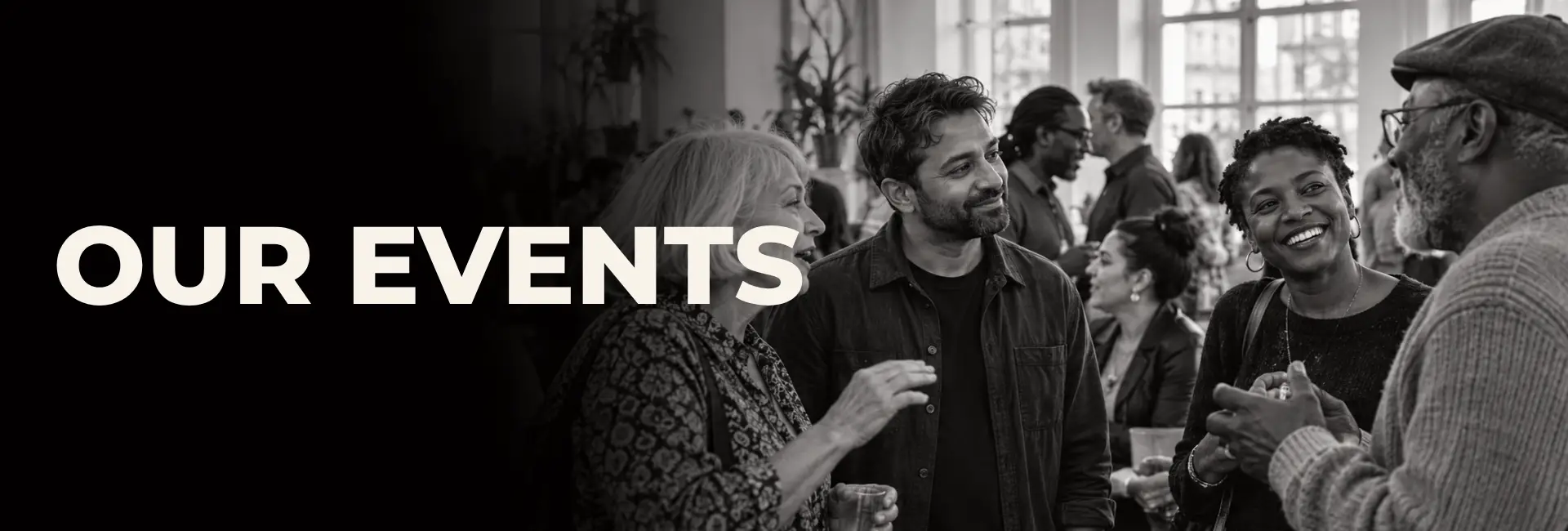
We look at what’s already happening in our communities, what people are telling us and where opportunities to come together might be missing.
That could mean having a reason to get dressed up, maybe it’s meeting new people or reconnecting with familiar places.
Our events are about more than filling a calendar. They’re about creating opportunities for people to take part in social and cultural life, feel welcome and enjoy a sense of belonging.

39% of Lambeth residents aged 65+ live alone (Census 2021 / Lambeth Council) although, living alone isn’t the same as being lonely. But, living alone is one part of a much bigger picture about how people stay connected, participate and enjoy themselves as they get older.
And older people aren’t one group. People have different interests, circumstances and ideas about how they want to spend their time.
Lambeth already has a substantial range of activities for older residents and we see this through the work and activities of Age UK Lambeth and Vida’s MYSocial activities and Active Lambeth’s sessions. The evidence doesn’t tell us that older people would rather go out in the evening.
It tells us that choice matters.
An intergenerational celebration stretching from afternoon into early evening, with 1950s and 1960s music, dancing, conversation and hospitality, created with Lambeth residents aged 65+ at its heart.
Research suggests that enjoyment, sociability, accessibility and flexibility can influence whether activities appeal to people, while transport and travelling after dark can create barriers for some older people (Boulton et al., 2018; TfL/Age Concern London, 2009).
That’s why we’re thinking about the whole experience, not just what happens once somebody walks through the door.
Published research can tell us a lot. But it can’t tell us exactly what older Lambeth residents want from Golden Memories.
So before the event, we’re speaking to older residents about what they already do, what’s missing, what might stop them attending, whether evening travel is a concern and what would make an evening like Golden Memories work for them.
Afterwards, we’ll look at what actually happened: who came, what helped, what got in the way, what people valued and what we could do better.
We’ll bring that together in our first Golden Memories Impact Report.
What we learn from the pilot will shape further Golden Memories events throughout 2027.
What we learn from the pilot will shape further Golden Memories events throughout 2027.

People arrive and leave. Businesses open and close. Familiar places disappear and new ones take their place. Different generations can experience the same neighbourhood very differently.
It got us thinking about belonging.
What makes somewhere feel like home?
What connects you to a place?
What happens to that connection when a neighbourhood changes?
And how do the people, places, memories and new stories of Brixton sit alongside each other?
And that’s the point.
Brixton Belongs is an idea we’re interested in exploring, not a project we’ve already designed.
From spring 2027, we want to start looking properly at the questions behind it, what’s already known and what people in Brixton have to say.
Only then will we decide whether there’s a gap for We’re Good to do something about (and what that something should be).
It could become an event.
It could become something completely different.
For now, it’s a question worth exploring.
What we learn from the pilot will shape further Golden Memories events throughout 2027.
Our event starting point is Golden Memories, but it won’t define every event We’re Good creates.
Future events will come from the gaps we notice, the things we learn and the opportunities we find to bring people together.
Some may be one-offs. Others, like Golden Memories, may develop over time.
And sometimes the right response won’t be an event at all.
To provide the best experience, we use cookies and similar technologies. With your permission, we use Google Analytics to help us understand how people use our website, figure out what's working, and see where we can improve. Consenting allows us to process data like browsing behavior or unique IDs; refusing or withdrawing consent may affect certain site features.